
NFL’s Stance on Player Activism: A Closer Look at Azeez Al-Shaair’s “Stop the Genocide” Message
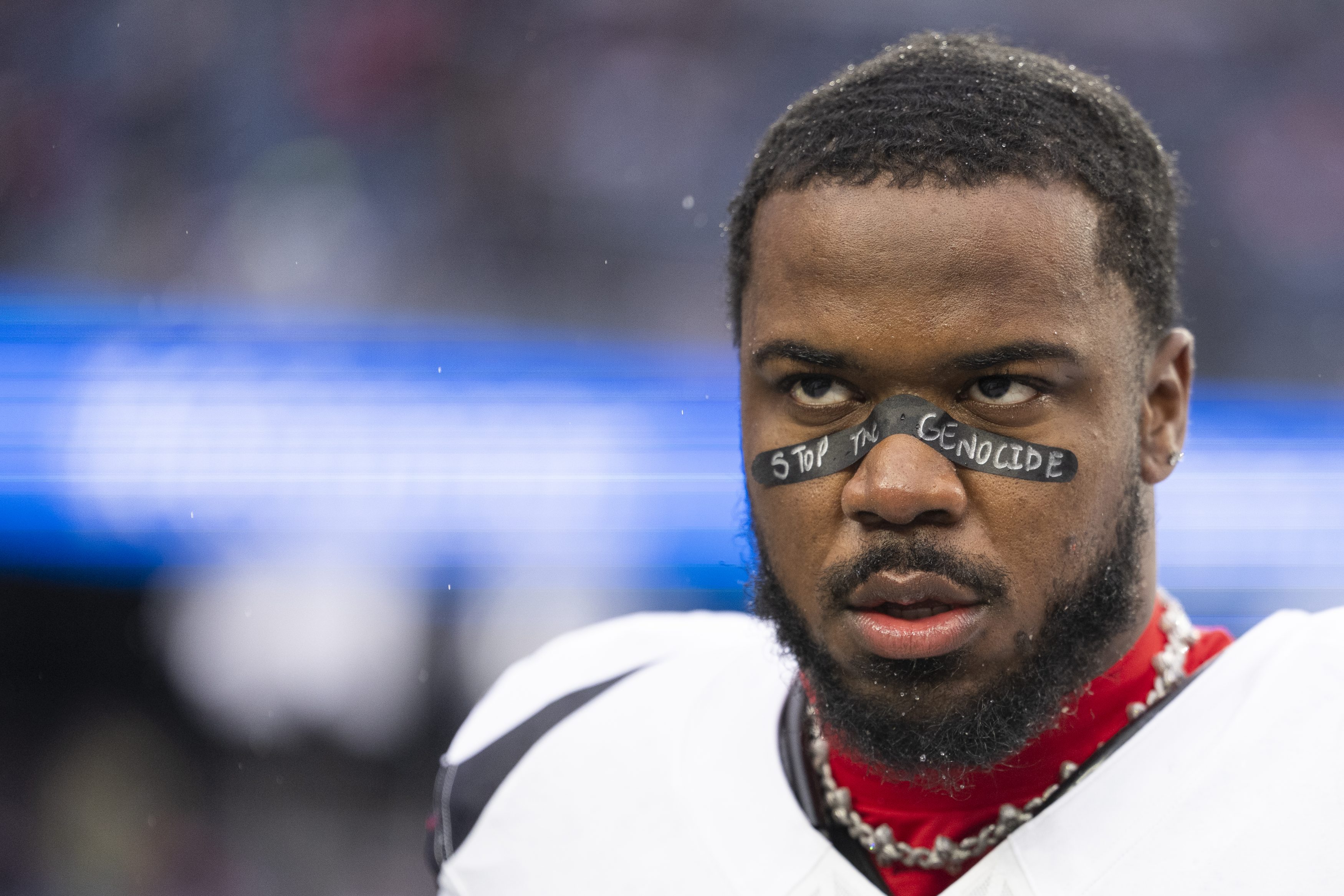
The National Football League (NFL) has long been known for its strict uniform policies, with players often facing fines for violating these rules. However, a recent incident involving Houston Texans linebacker Azeez Al-Shaair has raised questions about the league’s stance on player activism and freedom of expression. After wearing customized eye black with the message “Stop the Genocide” during a playoff game against the Pittsburgh Steelers, Al-Shaair was fined $11,593. But when he planned to wear the same message again for the team’s divisional-round game against the New England Patriots, he was told that the consequences would be more severe, potentially even resulting in his removal from the game.
As seen in the photo above, Al-Shaair did wear the same message prior to facing the Patriots, but he changed it to regular eye black before kickoff. Following Houston’s 28-16 loss to New England, Al-Shaair expressed his confusion and frustration with the league’s stance, citing the example of former teammate and current Patriots receiver Stefon Diggs, who regularly puts personalized messages on his eye black without facing similar consequences. “I knew that that was a fine,” Al-Shaair said. “But I was told that if I wore that in the game, I would be pulled out the game. So I think that was probably the part that I was confused about, because I understood that was a fine, but I ain’t never seen Stef get pulled out of a game for having eye tape with writing on it.”
Al-Shaair’s Message and the NFL’s Response
Al-Shaair’s message, “Stop the Genocide,” is a reference to the ongoing conflict in Gaza and the Palestinian territories. The linebacker has been an outspoken advocate for the Palestine Children’s Relief Fund, wearing cleats promoting the organization in 2023 and 2024. When asked about his decision to wear the message, Al-Shaair emphasized the importance of raising awareness about social justice issues, even if it makes people uncomfortable. “At the end of the day, it’s bigger than me. The things that are going on make people uncomfortable. Imagine how those people feel. I think that’s the biggest thing. I have no affiliation, no connection to these people, other than the fact that I’m a human being. If you have a heart and you’re a human being, you can see what’s going on in the world. You check yourself real quick.”
The NFL has a long history of fining players for uniform violations, with examples ranging from Frank Gore’s $10,500 fine for having his socks too low to DeAngelo Williams’ denied request to wear pink for the entire season to raise breast cancer awareness. While the league has relaxed some of its rules in recent years, allowing players to wear customized shoes during designated weeks, the incident with Al-Shaair raises questions about the consistency and fairness of these policies. As Al-Shaair noted, league discipline for personalized eye black typically ends at a fine, making it unclear why his case would be treated differently.
Seeking Clarity from the NFL
In an effort to understand the NFL’s stance on this issue, I reached out to the league for comment. NFL spokesperson Brian McCarthy confirmed that Al-Shaair was fined for violating the league’s uniform and equipment rules but referred me to the rulebook for further clarification. The cited article in the NFL rulebook states that the Commissioner may impose independent disciplinary action on the club and involved player, up to and including suspension from the team’s next game. However, this does not fully explain why Al-Shaair was told that he would be removed from the game if he wore the customized eye black.
As of publication, the NFL has not responded to follow-up questions seeking further clarification on this matter. The Texans also did not reply to a request for comment. The available evidence suggests that the NFL, at the direct behest of Roger Goodell, would have been willing to ban a player from an important playoff game over an anti-genocide message. This incident highlights the need for greater transparency and consistency in the league’s policies on player activism and freedom of expression.
Ultimately, the NFL’s stance on player activism and social justice issues remains a complex and contentious topic. While the league has made efforts to promote social responsibility and community engagement, incidents like the one involving Azeez Al-Shaair raise important questions about the balance between enforcing uniform policies and respecting players’ rights to express themselves. As the NFL continues to navigate these issues, it is essential to prioritize clarity, consistency, and fairness in its policies and decision-making processes.